
Classification and labelling of dangerous goods – ADR – IMO
Classification and labelling of any goods considered dangerous and to be transported by any mode of transport (road, air, sea, rail and river)
Clase 1: Explosives
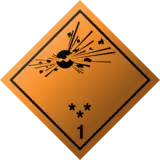
1.3 – Explosive substances and objects
Applies to explosive substances and objects covered by sections 1.1, 1.2 and 1.3. Conventional sign of a bomb exploding
Note: ** Division indication
* Compatibility group indication
1.4 – Explosive substances and objects
Substances and articles that present a minor explosion hazard in the event of ignition or priming during transport.
1.5 – – Explosive substances and objects
Substances and articles that present a minor explosion hazard in the event of ignition or priming during transport.
1.6 – Explosive substances and objects
Extremely insensitive articles which do not have a mass explosion hazard



Clase 2: Gases
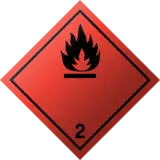
2.1 – Flammable gas
Applied to flammable gases in a mixture of up to 13% with air
2.2 – Non-flammable non-toxic gas
Applied to materials that at 50°C have a vapour pressure greater than 300 kPa (3 bar) or are in a fully gaseous state at 20°C, at a standardised pressure of 101.3 kPa
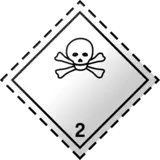
2.3 – Toxic gas
Known to be toxic or corrosive to humans to the point of posing a danger to their health. They are assumed to be toxic or corrosive to humans because their CL50 for acute toxicity is less than or equal to 5,000 ml/m3

Clase 3: Flammable liquids
That they have a maximum flash point of 61°C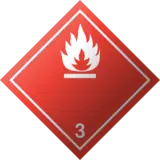
Clase 4: Flammable solids
4.1 – Flammable solid substances
Which can ignite by rubbing, self-reactive materials, thermally unstable materials and desensitised explosive materials, materials that have been moistened with alcohol or water to cancel out their explosive properties
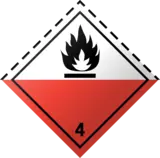
4.2 – Spontaneously flammable substances
This includes pyrophoric materials and substances that ignite spontaneously
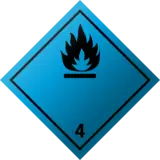
4.3 – Substances that give off flammable gas when in contact with water
These are substances that, when they react with water, give off flammable gas that can form explosive mixtures with air

Clase 5: Oxidising substances
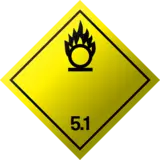
5.1 – Oxidisers
These are substances that, since they give off oxygen, cause or promote the combustion of other materials
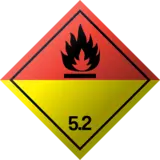
5.2 – Organic peroxides
These are subject to exothermic decomposition at normal or high temperatures
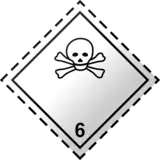
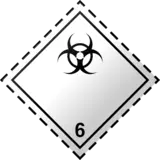
Clase 6: Toxic and infectious substances
6.1 – Toxic materials
These are substances that can harm human health or cause death by inhalation, skin absorption, or ingestion
6.2 – Infectious substances
These are substances which are known or are reasonably expected to contain pathogens
Clase 7: Radioactive substances
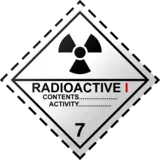
7.A – Radioactive materials, white category I
These are substances that emit particles and radiation capable of causing damage to cells
Maximum radiation intensity at any point of the external surface does not exceed 0.005 mSv/h.
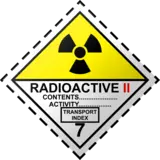
7.B – Radioactive matter, yellow category II
Maximum radiation intensity at any point on the external surface, more than 0.005 mSv/h but no more than 0.5 mSv/h.
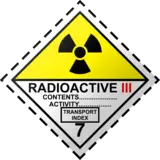
7.C – Radioactive matter, yellow category III
Maximum radiation intensity at any point on the external surface, more than 0.5 mSv/h but no more than 2 mSv/h.
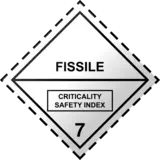
7.E – Fissile materials
Maximum radiation intensity at any point on the external surface. Fissile matter means uranium 233, uranium 235, plutonium 239 or plutonium 241, or any combination of these radionuclides
Clase 8: Corrosive substances
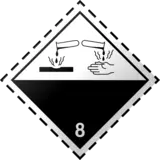
These are substances that, through their chemical action, damage the skin epithelial tissue and mucous membranes when they come into contact with them, or that, in the event of leakage, may cause damage to other goods or means of transport or destroy them
Clase 9: Materias y Objetos peligrosos diversos
9 – Materias y Objetos de peligro diverso
Incluyen materias y objetos que, a lo largo del transporte, supongan un peligro diferente de los que contemplan las restantes clases
9.A – Materias y Objetos de peligro diverso, Pilas de Litio
Incluyen materias y objetos que, a lo largo del transporte, supongan un peligro diferente de los que contemplan las restantes clases